Sustainability and Governance

Governance

At Alexela, our decisions are guided by value-based management: we operate honestly, transparently and responsibly, focusing on customer trust, employee safety and the continuity of critical infrastructure. Our management practices are based on our code of conduct, our strategic objectives and the applicable legislation.

Zero tolerance and clear rules

We have zero-tolerance towards corruption and bribery, and we do not accept dishonest business practices, including conflicts of interest, fraud or breaches of competition rules. Decisions and transactions are made in the best interests of the company, and internal control and approval rounds are used to mitigate risks.

Data protection and cyber security

We protect the data of our customers, employees and partners, and we are constantly improving our information security. The role of digital solutions is growing, which is why we are paying particular attention to data protection, access control and the prevention of cyber risks.

Whistleblowing and fair practices

A fair and safe working environment requires that problems are identified at an early stage. For this reason, Alexela has set up a whistleblowing channel, which can be used to report suspected unethical behaviour, conflicts of interest, fraud or other breaches. Reports are treated confidentially, and the aim is to prevent harm and introduce improvements.

Role of managers and staff awareness

The strength of leadership culture depends on the example set on a day-to-day basis. The induction of new employees includes an introduction to the company's values and code of conduct, supplemented by regular training sessions (including on data protection and cyber security). The organisation's openness is supported by regular internal communication and joint information sessions, where developments are shared and changes are discussed.

We strengthened the practical pillars of our management culture

We fostered open dialogue in the organisation, supported the development of a more inclusive working culture, and contributed to the systematic development of the working environment and wellbeing. Our goal is for Alexela to be a workplace where high standards are clear, where people feel safe to raise concerns, and where management supports both results and sustainability.

Management Board

In 2025, the activities of AS Alexela were managed by a two-member management board, comprising:

Marti Hääl

Marti Hääl

Chairman of the Management Board

Karmo Piikmann

Karmo Piikmann

Member of the Management Board (until August 2025)

Supervisory Board

In 2025, the supervisory board of AS Alexela consisted of five members, comprising:

Veiko Räim

Veiko Räim

Chairman of the Supervisory Board

Heiti Hääl

Heiti Hääl

Member of the Supervisory Board

Mikhail Kazarin

Mikhail Kazarin

Member of the Supervisory Board

Andreas Laane

Andreas Laane

Member of the Supervisory Board

Priit Penjam

Priit Penjam

Member of the Supervisory Board

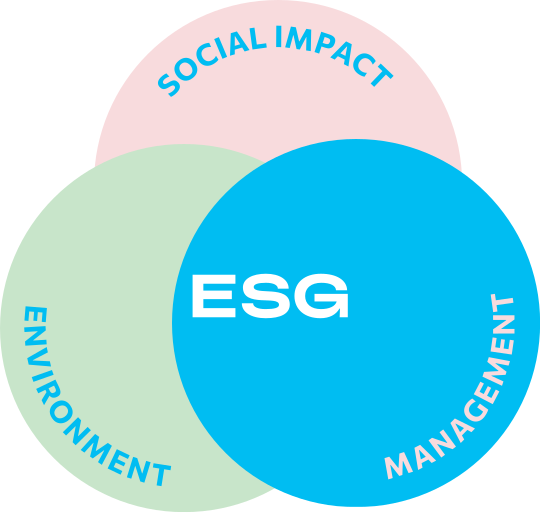
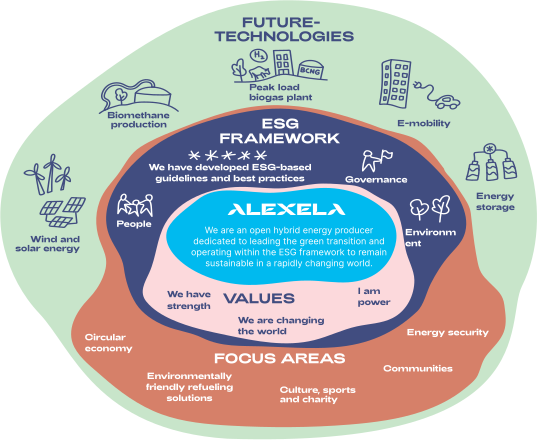
ESG illustration

Sustainability

Alexela is the energy company with the widest product range in Estonia. We want to actively support every household and company. The share of renewable energy in Alexela's energy portfolio is growing and its goal is to offset the impact of fossil fuels in households (at home), transport (on the road) and business (at the destination).

The company's development is based on maintaining a consistent focus on the environmental, social and governance (ESG – environmental, social, and governance) principles. Tackling climate change is important, but social and governance aspects are also crucial to ensuring sustainable development.

The company's management board and sustainability manager are responsible for ESG at Alexela. Each area manager is responsible for ensuring that ESG issues are integrated into the achievement of the area's objectives within their area of responsibility.

In order to map and better manage key ESG issues, we have carried out a Double Materiality Assessment, in which we involved the company's main stakeholders. We have identified our impact on the environment and society, as well as the sustainability-related risks we are exposed to. Alexela's most significant areas of impact concern climate change, its workforce, consumers and end-users, and business conduct, as well as pollution, the circular economy and affected communities.

Environmental impacts and risks are directly linked to our strategic activities as we transition from a business model based primarily on fossil fuels to smart renewable energy, decentralised generation, storage, distribution and sales.

The introduction of new renewable energy solutions will mitigate the climate impact, but at the same time it requires significant investments in a new business sector whose effectiveness we cannot yet assess realistically. On the other hand, we are threatened by less favourable funding conditions should our sustainability performance be poor, as well as a decline in competitiveness if we fall behind in research, development and innovation.

The transition to a more sustainable business model also affects our employees, customers and end-users. We focus on ensuring that the change process is inclusive and communicated clearly and responsibly, and that the safety and security of our products and services – including data protection – are guaranteed for our own employees, partners and customers.

All of this is supported by a responsible corporate culture, value-based behaviour, cooperation with organisations that share the same values, and contributing to the quality of legislative drafting through professional organisations.

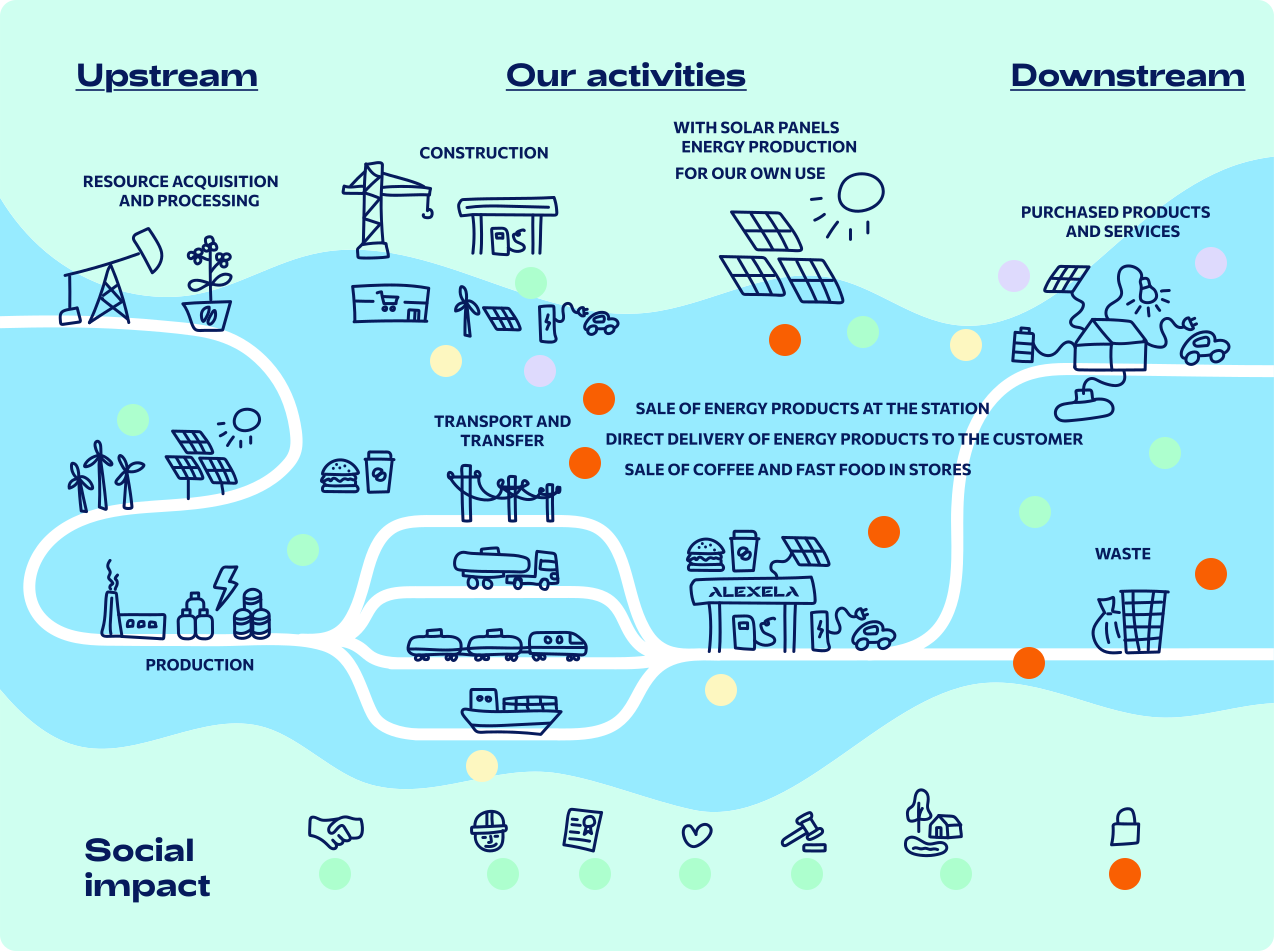
Alexela value chain

Click on the numbers to explore the impacts, risks and opportunities.

Alexela value chain
1
2
3
4
5
6
7
8
9
10
11
12
1
2
3
4
5
6
7
1
2
3
4
1
2
3
1 Positive impact
Development and provision of distributed generation and energy storage solutions.
2 Positive impact
Development and provision of renewable energy and alternative fuels.
3 Positive impact
Use of secondary raw materials and waste in bioenergy production. Resource-efficient gas management.
4 Positive impact
Ensuring safe working conditions. Valuing employees.
5 Positive impact
Training and development of employees.
6 Positive impact
Safety communication. Responsible marketing practices.
7 Positive impact
Safety communication and ensuring safety.
8 Positive impact
Responsible corporate culture and value-based behaviour.
9 Positive impact
Contributing to the quality of legislation through member organisations.
10 Positive impact
Reasonable payment practices. Setting environmental and social conditions.
11 Positive impact
Provision of essential services, contributing to security of supply and energy security. Contributing to communities.
12 Positive impact
Development and provision of alternative energy solutions.
1 Negative impact
GHG emissions from our own activities and value chain.
2 Negative impact
Energy consumption in our own activities and value chain.
3 Negative impact
Petrol vapours, micro-pollution.
4 Negative impact
Use of plastic packaging.
5 Negative impact
Large-scale transfer of resources between value chain partners.
6 Negative impact
Waste generation in our own activities and value chain.
7 Negative impact
Large-scale management of personal data.
1 Risks
Legislation on GHG emissions trading and changes in excise duties.
2 Risks
Less favourable funding conditions in the case of poor sustainability performance.
3 Risks
Investment risk of innovative technologies.
4 Risks
Decline in competitiveness if we fall behind in research, development and innovation.
1 Opportunities
Growth in demand for renewable energy and alternative fuels.
2 Opportunities
Growth in demand for energy storage technologies.
3 Opportunities
Development opportunities in energy technology innovation.

Our focus topics

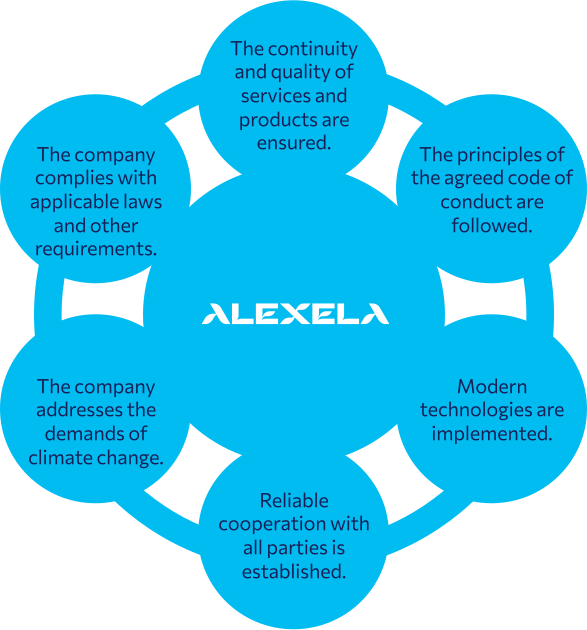
The implementation of the integrated guiding principle is based on the following principles:
Focus diamond

Alexela's sustainability strategy is aligned with both national and European standards and rules. We take into account the stakeholders who may be affected by our activities. Today's sustainable operations are supported by various management systems that have been certified by third parties and which are one of the most important tools in our daily work.

Read more link outside icon
Stakeholders

Sustainability strategy

Stakeholders

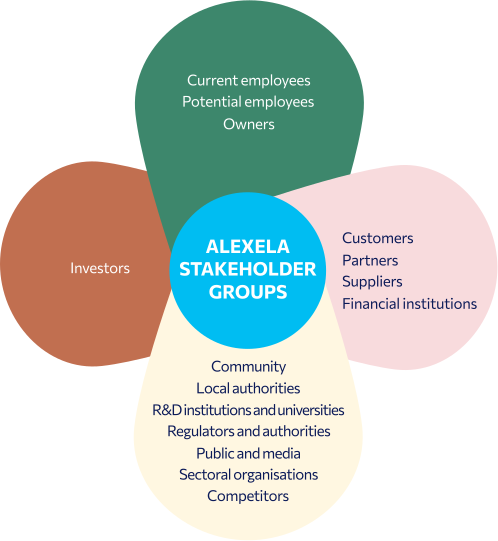
Reliable cooperation with its main stakeholders is important for Alexela, including employees and owners, customers and suppliers/partners, the community and local governments, as well as regulators and supervisory authorities. Alexela has the strongest interaction with these stakeholders.

Energy as a service

Sustainability at Alexela

Alexela's focus topics are the development of environmentally sustainable refuelling solutions, the development of the circular economy, contributing to energy security, empowering communities, and supporting culture, sport and charity. The focus topics are set on the basis of the company's areas of greatest impact and input from the most important stakeholders. Within the focus topics, we monitor our activities with the greatest care, and through them we have the greatest influence on eight UN Sustainable Development Goals (SDGs). So far, we have gathered stakeholder input through annual surveys and direct communication.

Environment

Achieving environmental objectives through innovation

Alexela is constantly changing its business and development practices to reduce environmental impact and implement the principles of circular economy. Our objectives are in line with the Paris Climate Agreement and the Green Transition Action Plan. We focus on reducing our carbon footprint and give preference to suppliers whose environmental policies are in line with our own. All Alexela employees must respect the environment and act in accordance with the code of conduct.

Alexela's goal is to achieve carbon neutrality in its operations (Scopes 1 and 2) by 2030. We have been measuring our carbon footprint since 2020 and have verified the results for the base year. Under the GHG Protocol, calculations for Scopes 1 and 2 are mandatory, whilst Scope 3 is voluntary. Companies can therefore begin by mapping out the most immediate impacts. For Scope 3, we use a tiered approach, incorporating various relevant impact categories depending on the availability of data and the options available. Work and activities in this area are continuing.

Transition plan for climate change mitigation

Alexela's main environmental impact stems from our energy portfolio. Environmental principles form part of our strategy to mitigate climate change. We monitor and measure the achievement of our environmental targets.

Our activities focus on reducing emissions, and we have set ourselves the target of achieving carbon neutrality in our operations by 2030 (Scopes 1–2). In order to achieve this, we use 100% green electricity ourselves; in addition, we generate, purchase and offer renewable energy to our customers. In addition, we have converted nearly half of our fleet of cars and lorries to electric, bio-LNG and bio-CNG.

As Alexela's most significant impact areas relate to climate change, a significant part of the company's business activities is focused on developing more environmentally friendly solutions and ensuring sustainability, thereby contributing to both the natural environment and local communities:

  • the development of less polluting refuelling solutions, such as biomethane and hydrogen filling stations, and e-mobility.
  • Biomethane production based on the principles of the local circular economy.
  • The development of solar and wind farms, including storage facilities.
  • Developing renewable energy storage capacity, such as Zero Terrain's pumped hydro storage facility in Paldiski.
  • The Rohesärts green electricity package.
  • Alexela also engages its customers through community and national defence initiatives, enabling them to contribute both to environmental activities (such as tree planting) and to Estonia's national defence via the Reserve Forces Fund.
  • Promoting biodiversity, for example through the insect drive-in project in the green areas at Alexela filling stations.
  • Rewarding reuse in retail, for example, hot drinks at a reduced price when using a reusable cup, and Alexela water packaged in recycled plastic bottles.

Impact of the regulatory environment

The year 2025 confirmed that a constantly and rapidly changing regulatory environment is the new reality in the energy sector, resulting in reduced predictability and heightened risks within the sector. This new situation calls for more effective cooperation than before, readiness to adapt more quickly, and a stronger call for high-quality legislative drafting.

The Omnibus Package, adopted in late 2025, will have a significant impact on sustainability reporting in Estonia, as it reduces the number of companies subject to reporting requirements by approximately 80%, leaving only companies with more than 1,000 employees in the mandatory CSRD reporting framework. As a result of this change, Alexela is no longer required to report on sustainability. In addition, the implementation of sustainability reporting is being postponed by two years, which means that many Estonian companies will not have to submit their first reports before 2028. The Omnibus also restricts the right of large companies to require extensive sustainability information from smaller Estonian suppliers.

Russia's ongoing aggression in Ukraine has kept the energy policy of the European Union focused on achieving greater independence from aggressor states than before. We played an active role in refining the sanctions policy of the Estonian Tax and Customs Board and the Ministry of Foreign Affairs, and in strengthening supervision of the LPG and LNG markets. We also drew the legislator's attention to the need to remove national market barriers to liquefied biomethane that are incompatible with EU law, which would mean lower fuel prices for consumers.

The synchronisation of the electricity systems of the Baltic States with the Continental European frequency zone, which took place in early 2025, is a landmark step towards enhancing Estonia's energy security. However, this necessary transition was an economic shock to market participants due to the activities of Elering, as costs in both the capacity market and the energy market turned out to be significantly higher than forecast. Although, under pressure from market participants, political decisions were made to extend the application of the capacity reserve procurement charge (also referred to as the frequency reserve charge or balancing capacity charge) to consumers and producers, postponed until 2026, legal clarity regarding such a charge has not yet been established. It is also unclear whether the application of such a charge is proportionate in relation to consumers and producers.

Now that the European Union's Fit for 55 package has reached the transposition and implementation phase, it has become clear that the current, overly slogan-driven policy needs to be adapted. In light of this, our focus is primarily on preparations for the reform of the Emissions Trading System (ETS) and the implementation of the new Emissions Trading System for road transport and buildings (ETS2). The entry into force of the ETS2, which is expected to have a significant impact (with the addition of a CO2-based excise duty) on consumption decisions in the fuel and gas markets and related investment decisions, has been postponed, and the directive is caught in a political crosswind.

With regard to the Renewable Energy Directive, we waited for the government's decision on what would serve as the benchmark for meeting renewable energy targets in the transport sector where, from a statesman's perspective, a GHG reduction target would clearly be preferable, as this would allow to simultaneously reduce fuel costs for consumers (including transport operators and local authorities), send a strong investment signal to domestic biomethane producers in the agricultural sector, and enable the Estonian agricultural sector to meet its own GHG reduction targets. Regrettably, the government postponed making these decisions.

In addition, work on developing a regulatory framework for hydrogen and other new energy carriers of non-biological origin has gathered pace; however, this progress remains too slow in comparison with the state's obligations. Even under these circumstances, we opened a public H2 filling station. However, in order to meet expectations for future developments, the state must, in cooperation with market participants, draw up and implement a plan that would provide greater legal clarity and certainty than at present, so that the investment decisions necessary for the development of the Estonian economy do not remain merely on paper. The Renewable Energy Directive is expected to be transposed into Estonian law in 2026, which in our view would provide the necessary legal certainty.

We are convinced that only trust-based cooperation between the public and private sectors can create a stable regulatory environment that supports both Estonia's energy security, the achievement of climate targets and the competitiveness of Estonian companies. As a domestic family-run business, we continue – despite the regulatory uncertainty – to invest in solutions that strengthen Estonia's energy independence and create long-term value for Estonian society.

Our people

Our people – our strength

Alexela employs over 500 professionals who contribute to making the world a better place every day. Our employees interact with Estonian people both at filling stations and cafés, where they provide rest breaks and a selection of food, and via digital channels, where we offer round-the-clock customer service. Whether people need advice on finding the best electricity tariff or quick help with various issues – we're always here for them.

We value our people in every role. We value both our long-serving staff, who share their valuable experience and help ensure the company's continuity, and our new recruits, who bring fresh ideas and knowledge. The recruitment and management of employees are based on the values developed in 2019, which support value-based management.

Value-based management and culture

Every one of our employees shares and upholds our core values: 'I am a force – and my work is valuable', 'There is strength in us – and we support one another', 'We are changing the world – by ensuring that life in Estonia gets better'. These values are not just words – they are brought to life in our day-to-day work. We believe that creating a value-based culture requires the involvement of all employees at every level; that is why our employees were involved in the process of developing our values right from the start. Only by working together can we create a company where our values truly come to life and evolve.

Employees of AS Alexela and its subsidiaries

As at 31.12.2025

Year 31.12.2023 31.12.2024 31.12.2025
Number of employees 524 538 520
Members of the management board 10 10 6
Managers and specialists 189 210 200
Service staff and workers 325 318 314
Supervisory board and management board 28 28 13
Women 0 0 1
Men 14 14 12
30-49 years 11 10 5
Over 50 years 3 4 6
New employees* 165 181 312
Women 118 136 248
Men 47 45 64
Under 30 years 62 84 187
30-49 years 72 67 91
Over 50 years 31 30 34
Employees who left* 333 303 328
Women 237 212 231
Men 96 91 97
Under 30 years 217 175 171
30-49 years 63 86 98
Over 50 years 53 42 59
* Includes seasonal employees

Employee well-being and development

At Alexela, we regularly measure staff satisfaction through surveys and use the feedback we receive to develop our working environment in a targeted manner. In order to strengthen our employer brand, we carried out an employer survey last year, which helped us to better understand Alexela's strengths as an employer and to guide our recruitment and employee experience development initiatives. Each year, based on the results and discussions, we select three key areas for development in order to create an even more supportive and motivating working environment.

Our day-to-day work is based on our values and our code of conduct, which sets out the principles of health and safety, equal treatment and respect for human rights. The safety and wellbeing of our staff are our top priority – we comply with all legal requirements and expect the same from our partners to ensure a safe and healthy working environment. Alexela does not tolerate bullying, violence or harassment, and our recruitment is based on the principle of equality, with people being assessed on the basis of their professional qualities.

In order to support our employees' health and wellbeing, we carried out a health promotion survey, and we are using the results of this survey to develop a health promotion strategy. This helps to set clear objectives and focus our efforts where they will have the greatest impact. Our consistent contribution is also recognised by the Health Promoting Workplace label.

We offer our staff opportunities for development through discussions and training sessions, including 360-degree appraisals for managers, and we support their professional development through vocational and specialist training. We also offer a competitive salary; we regularly monitor the labour market when setting our pay rates and pay above the average. In addition, we value a healthy and active lifestyle through sports allowance, health insurance and joint events.

Valuing our employees is at the heart of Alexela's culture – our people are the ones who shape the company's reputation and our shared way of working. Traditional joint events, such as Alexela Energy Day and Power Day, also help to maintain and strengthen the team spirit.